The regulatory landscape in the U.S. is shifting fast when it comes to anti-money laundering (AML). Several new rules, legislative acts, and clarifications are being proposed or developed, and they’ll affect not just big banks but fintech’s, advisory firms, stablecoin issuers, and anyone operating in digital assets. Below are key regulations to keep an eye on.
Major Regulatory Changes in Progress
- FinCEN’s Investment Adviser AML / CFT Program Rule – Effective January 1, 2028
- Originally, registered investment advisers (RIAs) and exempt reporting advisers (ERAs) were to comply by January 1, 2026.
- As of July 2025, the deadline has been postponed to January 1, 2028, giving firms more time to prepare.
- What to prepare: Don’t wait. Advisers should start designing AML compliance programs, SAR/CTR reporting systems, and risk assessments well before 2028.
- Proposed Rule to Strengthen & Modernize AML/CFT Programs – Introduced June 2024
- FinCEN’s proposal makes AML programs more effective, risk-based, and tailored, aligning with the AML Act of 2020.
- No final date yet, but businesses should assume enforcement could begin within the next 18–24 months once finalized.
- Corporate Transparency Act (CTA) – Revised March 2025
- Companies must disclose beneficial owners.
- As of March 2025, domestic companies are no longer required to file BOI reports, while foreign companies doing business in the U.S. still must.
- Expect further clarifications over the next 1–2 years as FinCEN updates reporting instructions.
- GENIUS Act (Stablecoins Regulation) – Enacted Mid-2025
- Signed into law in July 2025, the GENIUS Act establishes the first federal stablecoin framework.
- Key obligations take effect gradually over the next 12–24 months, including:
Monthly reserve disclosures and independent audits.
Restrictions on who can issue stablecoins, with some requirements kicking in by early 2026.
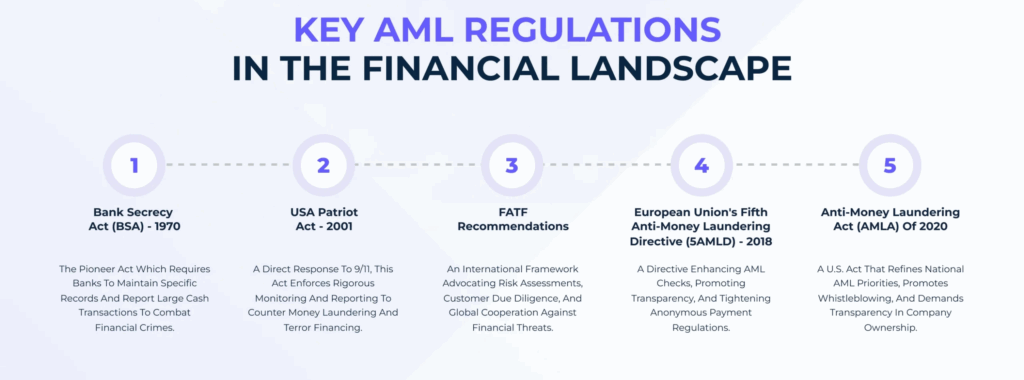
- Digital Asset AML Bills – Pending 2025–2026
- FIT21 (Financial Innovation and Technology for the 21st Century Act): progressing in Congress, with implementation expected if passed in late 2025 or 2026.
- Digital Asset Anti-Money Laundering Act: could expand AML duties across miners, wallet providers, and other players, with rollouts depending on legislative approval.
- Real Estate AML Reporting Rule – Effective December 1, 2025
- Issued in August 2024, the rule requires title and settlement agents to report all-cash residential real estate transfers involving legal entities or trusts.
- Businesses in this space have less than a year to update reporting systems before December 1, 2025.
Other Developments to Watch
Treasury exploring new AML technology: Treasury is actively seeking input on tools like AI, APIs, and digital ID systems. Expect new tech-focused guidance within the next 12 months.
White House report on stablecoins: Recommendations include requiring freeze/reissue functions for systemic stablecoin issuers — potentially shaping updates in 2026 and beyond.
FinCEN advisories: Recent notices flag threats like Chinese laundering networks, sextortion scams, and misuse of crypto kiosks. Businesses should integrate these risks into immediate monitoring efforts.
Industry pushback: Stablecoin issuers and fintech’s are lobbying for clarifications. Adjustments or amendments may surface by 2026.
What These Changes Mean for Businesses
Broader coverage → More industries, from investment advisers to real estate, now face AML oversight.
Risk-based focus → One-size-fits-all compliance is no longer acceptable. Regulators expect firms to build programs that reflect their specific risks.
Greater alignment → U.S. rules are converging with global AML standards, making it easier to operate across borders — but harder to exploit weak jurisdictions.
Tech-driven compliance → Expect regulators to push adoption of blockchain analytics, AI-powered monitoring, and stronger KYC tools.
The Road Ahead
These upcoming AML regulations aren’t just regulatory overhead—they’re shaping the future of finance. Businesses that stay ahead of them will benefit through credibility, smoother cross-border operations, and stronger risk management.
For those in crypto, fintech, or financial advisory, the regulatory playing field is becoming more defined. With clearer rules on the horizon, compliance can become a competitive advantage, not just a cost.
The key question to ask is: Are we preparing today for the rules of tomorrow? Those who do will not only avoid last-minute scrambles but also position themselves as trusted leaders in the next era of finance.